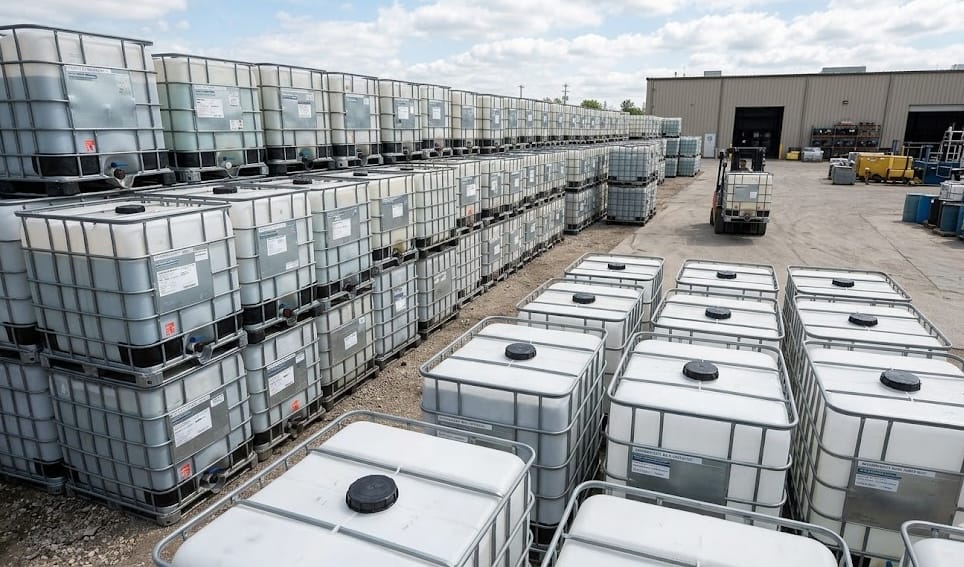
Our Environmental Impact
We believe in measuring what matters. Here is the data behind our environmental commitment — updated regularly as we continue to grow our impact.
Let's Work Together
Fill out the form and our team will craft a personalized quote just for you.
24-Hour Response
Every inquiry gets a personal reply.
No Obligations
Free quotes, zero pressure.
Eco-First
120 lbs saved per tote recycled.
Making a Measurable Difference
Every IBC tote we recycle keeps hundreds of pounds of plastic and steel out of landfills. Here's what our work adds up to.
IBC Totes Recycled
Gallons Waste Diverted
CO2 Emissions Prevented
Trees Equivalent Saved
How We Calculate Our Impact
Our impact numbers are based on peer-reviewed lifecycle assessment (LCA) data for HDPE plastics and galvanized steel. When we recycle or reuse an IBC tote, we calculate the savings versus manufacturing a new replacement from virgin materials. We use conservative estimates from the EPA WARM model and published LCA literature — the actual impact is likely higher.
The calculation includes avoided raw material extraction (crude oil for HDPE, iron ore and zinc for galvanized steel, timber for pallets), avoided manufacturing energy (extrusion, blow molding, welding, galvanizing), avoided transportation of raw materials and finished goods, and landfill space saved. We also factor in the energy used in our own recycling process to arrive at a net impact figure.
Every quarter, we audit our numbers against actual processing records. The tote count comes directly from our inventory management system. Material weights are based on manufacturer specifications verified by periodic spot-weighing. CO2 equivalents use EPA conversion factors. Water savings are calculated from our metered facility water consumption versus industry benchmarks for virgin production.
Impact Per Single IBC Tote
CO2 Prevented
By reusing instead of manufacturing new from virgin materials
Landfill Space Saved
Per tote diverted from disposal — HDPE takes 450+ years to decompose
HDPE Recovered
High-density polyethylene returned to manufacturing supply chain
Steel Recovered
Galvanized steel recycled — 100% recyclable with no quality loss
Water Saved
Manufacturing water consumption avoided through reuse
Energy Saved
Versus producing HDPE and steel from virgin raw materials
Oil Not Consumed
Crude oil that would be needed to produce 50 lbs of virgin HDPE
Zinc Preserved
Zinc coating on galvanized steel that does not need to be mined
Wood Saved
Timber for pallet base recovered as mulch or biomass instead of harvested new
Cumulative Impact Since Founding
| Metric | Total | Equivalent |
|---|---|---|
| IBC Totes Processed | 47,500+ | Enough to fill 6 football fields stacked 2 high |
| CO2 Emissions Prevented | 856 tons | Equivalent to taking 186 cars off the road for a year |
| Material Diverted from Landfill | 5.7M lbs | Weight of approximately 38 blue whales |
| HDPE Plastic Recovered | 2.4M lbs | Enough to make 12 million recycled bottles |
| Steel Recycled | 2.6M lbs | Could build 130 average-size cars |
| Water Saved | 9.5M gal | 14 Olympic swimming pools worth of manufacturing water avoided |
| Energy Conserved | 7.1M kWh | Enough to power 650 US homes for a year |
| Trees Equivalent | 14,000+ | CO2 absorption equivalent of a 35-acre forest |
The Bigger Picture: Why IBC Recycling Matters
Globally, millions of IBC totes are manufactured every year. The raw materials — crude oil for HDPE, iron ore and zinc for galvanized steel — are finite resources extracted through mining and drilling operations that disrupt ecosystems. The manufacturing process consumes enormous amounts of energy and water, and generates greenhouse gas emissions at every stage.
When an IBC tote is discarded after a single use, all of that embodied energy and material is wasted. The HDPE plastic will sit in a landfill for 450 to 1,000 years, slowly fragmenting into microplastics that contaminate soil and groundwater. The galvanized steel will eventually corrode, but not before occupying valuable landfill space for decades.
The circular economy model — reuse, recondition, recycle — breaks this cycle. Every tote we put back into service displaces a new tote that would otherwise need to be manufactured. Every tote we recycle returns raw materials to the supply chain. The compounding effect is enormous: our 47,500 processed totes represent not just 856 tons of avoided CO2, but a fundamental shift in how industrial containers are managed in our region.
Our 2028 goal is to reach 100,000 cumulative totes processed. At that scale, we will have prevented over 1,800 tons of CO2 emissions, recovered over 12 million pounds of material, and established the IBC tote recycling infrastructure needed to serve the entire Southeastern United States. Every business that buys used, recycles responsibly, or partners with us moves that goal closer.
Be Part of the Impact
Every IBC tote you buy used, sell for recycling, or have reconditioned contributes to these numbers. You are part of the solution.