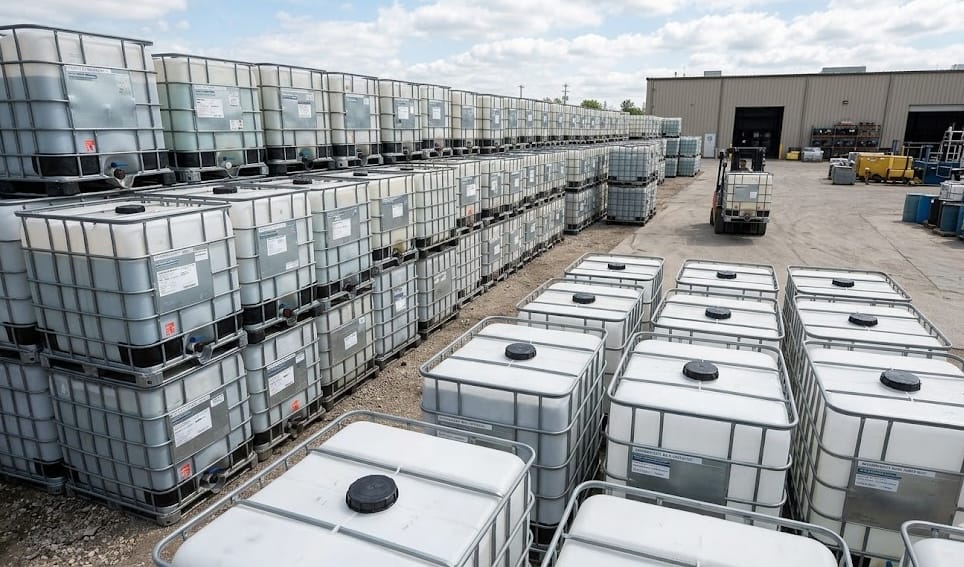
One of the most common questions we hear is: how many times can an IBC tote be reused before it needs to be recycled? The answer depends on several factors, but in general, a well-maintained IBC tote can go through 3 to 6 commercial use cycles, and sometimes more.
Commercial reuse cycles typically look like this: Cycle 1 — the tote is used by the original purchaser (e.g., a food manufacturer fills it with juice concentrate and ships it to a customer). Cycle 2 — the empty tote is collected, cleaned, inspected, and resold to another user (e.g., an agricultural operation for fertilizer storage). Cycle 3-5 — the tote is collected, reconditioned, and resold again, potentially cascading from food-grade to industrial applications as cosmetic condition declines.
Factors that limit reuse: UV exposure is the number one factor. HDPE becomes brittle after prolonged sun exposure, eventually leading to cracks and failure. Indoor storage between uses significantly extends lifespan. Chemical compatibility matters too — a tote used for aggressive chemicals may have reduced wall integrity even if it appears fine externally.
Physical damage is another limiting factor. Forklift impacts, drops, and improper stacking can damage the cage and bottle. A tote with a bent cage is harder to stack and may not support loads properly. Bottle cracks, no matter how small, make the tote unsuitable for liquid storage.
The cascade model: The IBC industry typically follows a cascade reuse model. A tote starts in the most demanding application (food-grade, pharmaceutical) and is successively reused in less demanding applications as it ages. A food-grade tote might become an industrial chemical container, then a water storage tank, then a garden planter, before finally being recycled.
End-of-life indicators: The tote should be recycled when any of these conditions exist — visible cracks in the bottle, severe UV yellowing with brittleness, cage structural failure that cannot be repaired, permanent contamination that cleaning cannot remove, or valve seat that cannot hold a seal even with new gaskets.
Environmental math: If an IBC tote achieves 5 use cycles before recycling, it displaces the manufacturing of 4 new totes. That represents 72 kg of avoided CO2 emissions, 480 pounds of virgin material not consumed, and significant energy and water savings. This is why reuse is even more impactful than recycling — it avoids the manufacturing step entirely.