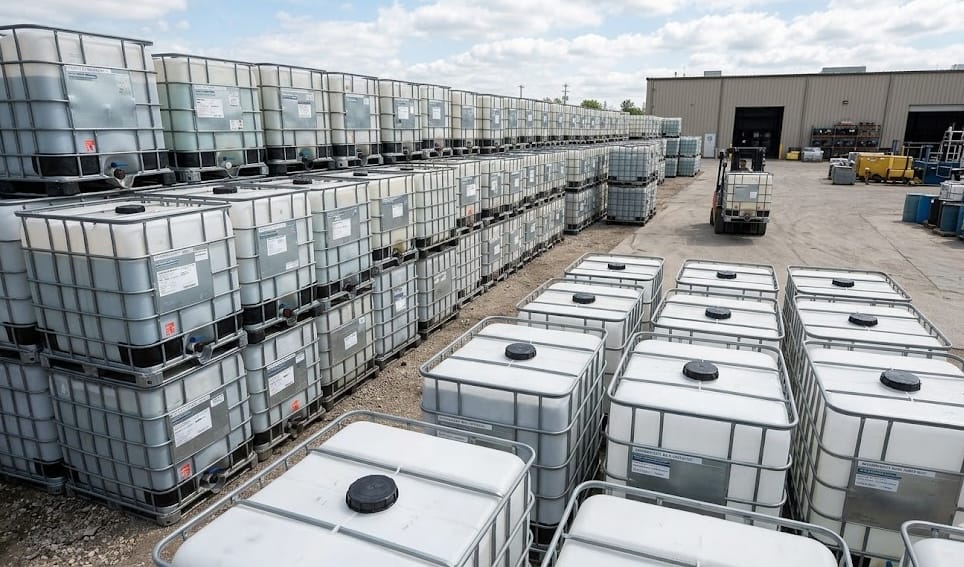
An Intermediate Bulk Container, commonly called an IBC tote or simply IBC, is a reusable industrial container designed for the transport and storage of bulk liquid and granulated substances. The standard IBC tote consists of three primary components: a blow-molded high-density polyethylene (HDPE) inner bottle, a welded galvanized steel outer cage, and a pallet base made of wood, plastic, or steel.
The most common IBC tote size in North America holds 275 US gallons (approximately 1,040 liters). Larger models hold 330 gallons or even 550 gallons. The 275-gallon version has external dimensions of roughly 48 inches long by 40 inches wide by 46 inches tall — perfectly sized to fit a standard pallet position in a warehouse, truck, or shipping container.
IBC totes were developed in the 1990s as a more efficient alternative to 55-gallon drums. A single 275-gallon IBC replaces five drums while occupying roughly the same floor space as four drums on a pallet. This means you can store more product in less space and handle fewer individual containers — reducing labor, shipping costs, and the risk of spills during transfer.
The HDPE bottle is the core of the IBC. This food-grade plastic is resistant to a wide range of chemicals, does not corrode, and can withstand repeated filling and emptying cycles. It is blow-molded as a single piece, eliminating seam leaks. The typical wall thickness is 2-3 mm, providing a balance between durability and weight.
The steel cage serves multiple functions. It protects the plastic bottle from impact damage during handling and transport. It provides structural rigidity for stacking — most IBCs can be safely stacked two-high when full, with the upper tote resting on the cage of the lower one. And it enables forklift handling via the pallet base.
At the bottom of the tote is a 2-inch butterfly valve (sometimes a ball valve) that allows controlled dispensing of the contents. The top features a 6-inch (150mm) fill opening with a threaded cap. Some models include a vented cap for pressure equalization during filling and emptying.
IBCs are used in virtually every industry that handles liquids in bulk: food and beverage (juices, oils, syrups), chemicals (solvents, acids, bases), agriculture (fertilizers, pesticides), pharmaceuticals, cosmetics, paints and coatings, and many more. They are also increasingly popular for non-industrial uses like rainwater collection, aquaponics, and emergency water storage.
The regulatory framework for IBCs is governed by UN standards. Most commercial IBCs carry a UN31HA1 rating, indicating they meet international standards for the transport of hazardous and non-hazardous materials. The UN rating specifies the container type, material, maximum gross mass, and testing standards it has passed.